All trades · September 30, 2026
Best CRM for Contractors in 2026: How to Choose
The best CRM for contractors in 2026, chosen in four steps by trade, team size, published price and must haves, from a company that makes one of them.
Blog · Electrical
The best electrician CRM in 2026 for service, install and commercial shops, with published prices for six tools, from a company that makes one of them.
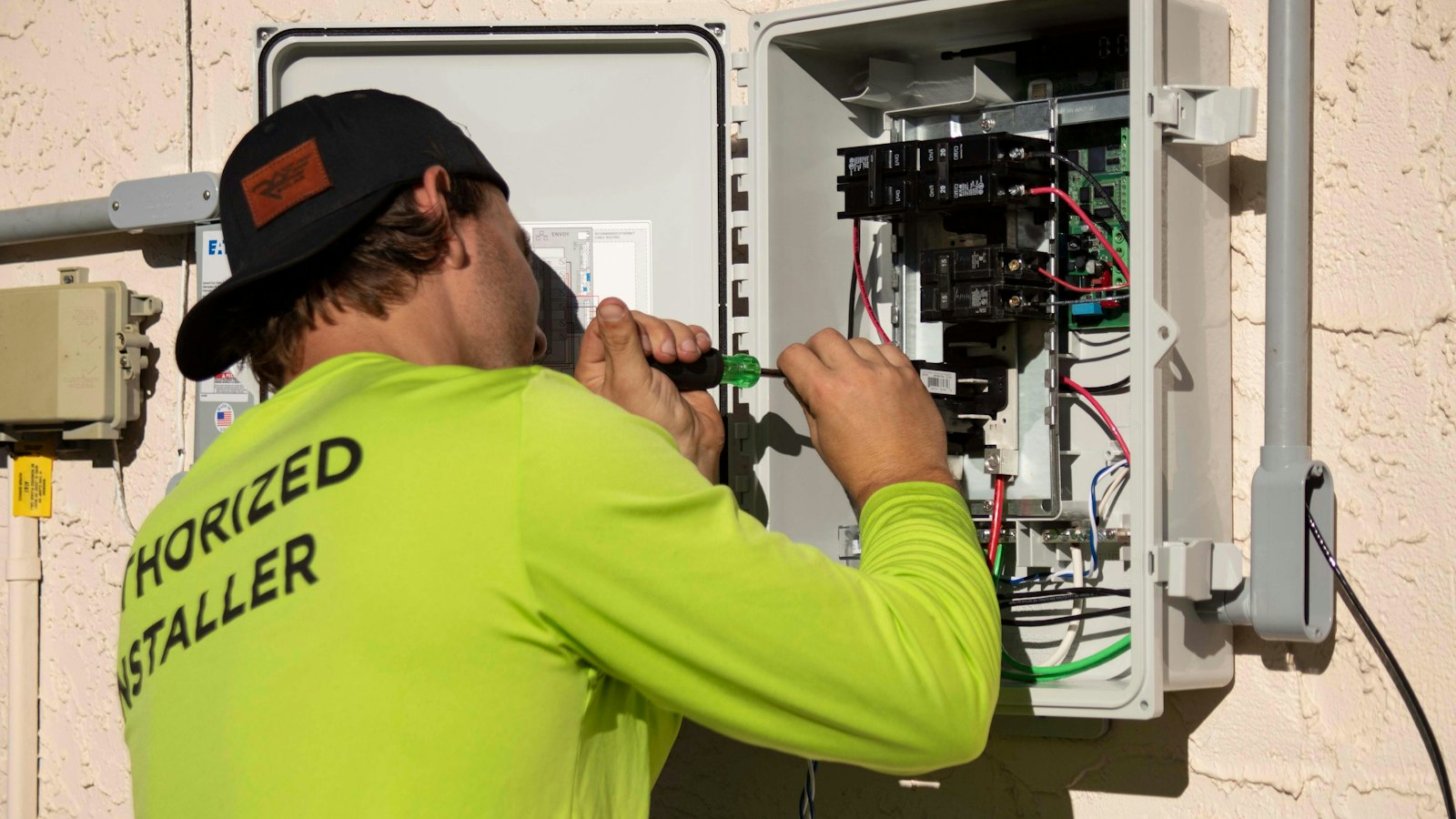
An electrical contractor's Tuesday can hold a breaker that keeps tripping at nine, a 200 amp panel upgrade waiting on the city inspector at noon, and an EV charger quote at four. The best electrician CRM is the one that handles all three without a second program: the service call priced on the spot, the permit tracked to a passed inspection, and the quote signed before you leave the driveway. This buyer guide sorts the options by the kind of electrical work you do, then prices each one from its own published page.
Quick answer. For a residential electrician in 2026, pick software built for service calls with flat rate options and permit tracking. Jobber has the lowest published start, $29 a month billed annually. Housecall Pro lists flat rate from $149. ServiceTitan fits large fleets. Commercial subs billing AIA pay applications should look at Knowify.
Cedar House Stack publishes this buyer guide and makes one of the products in it. Every competitor price and feature below was read on that company's own website on October 9, 2026. Where another product is the better fit, we say so.
The best electrician CRM depends first on where your money comes from: service calls, residential installs, or commercial contracts. A shop that lives on troubleshooting visits needs fast booking, flat rate options and payment at the door. A shop that lives on panel upgrades, EV chargers and generators needs deposits, permits and inspection dates. A commercial subcontractor needs progress billing and pay applications that a general contractor will accept.
Most electrical companies are a mix, which is why the software decision is harder than it looks. A product that is excellent at one kind of work can make the other two feel like a workaround. Start by writing down what share of last year's revenue came from each kind of job, then read the rest of this guide with that split in front of you.
You are a service shop if most jobs take one visit and the price is set at the door. You are an install shop if most jobs need a permit, a deposit and more than one trip. You are a commercial shop if most of your revenue is billed monthly against a contract with a general contractor.
Field service products such as Jobber, Housecall Pro, ServiceTitan and FieldEdge are built mainly around the service call. Knowify is built mainly around contract work. Cedar House Stack is built around the job and the address, with service calls and installs on the same record.
An electrical contractor needs a CRM that turns a phone call into a priced, signed and paid job, and keeps the permit, the inspection and the equipment on the record afterward. Here is the short list we would test on any product:
As of October 9, 2026, published electrician software prices run from $29 a month for one user to several hundred dollars a month for a ten person shop, and two of the six products publish no price at all. The table prices three common sizes from each company's own pricing page.
| Product | One user | Five users | Ten users | Built mainly for |
|---|---|---|---|---|
| Jobber | Core $29 a month billed annually ($49 monthly) | Connect $149 billed annually ($199 monthly) | Connect $229 billed annually ($299 monthly) | Service calls |
| Housecall Pro | Basic $59 billed annually ($79 monthly) | Essentials $149 billed annually ($189 monthly) | Max $299 billed annually for 8 users, then $35 a month per added user | Residential service |
| ServiceTitan | Not published | Not published | Not published, priced per technician | Large residential fleets |
| FieldEdge | Not published | Not published | Not published | Service with QuickBooks |
| Knowify | Core $99 billed yearly ($149 monthly) | Advanced $329 billed yearly, 10 users included | Advanced $329 billed yearly ($399 monthly) | Commercial contract work |
| Cedar House Stack | $99 a month | $495 for 5 Stack users, or $273 for 2 office users plus 3 technicians on Cedar House Field | $599 for 6 to 10 Stack users, or $472 for 3 office users plus 7 technicians on Field | Service calls and installs on one job |
Sources: Jobber pricing (read with team size set to "Just me", "2 to 5 people" and "6 to 10 people"), Housecall Pro pricing, the ServiceTitan and FieldEdge pricing pages, Knowify pricing and Cedar House pricing. Knowify's Service Pro add on for dispatch and maintenance agreements is $99 a month on top. Cedar House prices are founding prices, held for life by the first 50 companies.
On sticker price, Jobber and Housecall Pro cost less than Cedar House Stack for a five person shop where everyone works in the office software. The split rows show how an electrical shop would usually seat people on Cedar House: the owner and the office in the Stack, and the electricians on the field app.
Jobber publishes the lowest entry price here, Core at $29 a month billed annually for one user, with online booking, quotes, invoices with online payments and a website builder. Connect adds automated reminders, automatic payments, job checklists and a QuickBooks Online sync. Grow, $149 a month billed annually for one user or $229 for up to five, adds optional line items on quotes, job costing and two way texting.
Where it fits best: a one or two truck electrical service business that needs quotes, a calendar and invoices that get paid. If you want to show options on a quote, note that optional line items sit on Grow, not on Core or Connect.
Housecall Pro's Basic plan is $59 a month billed annually for one user and lists a price book and job costing. Essentials, $149 a month billed annually with 5 users, adds flat rate pricing, routes, checklist automations, employee GPS tracking, commissions and a QuickBooks Online sync. Max includes 8 users, then $35 a month for each added user, and adds recurring service plans, a sales proposal tool and open API access.
Where it fits best: a residential electrical service company that wants online booking from Google and flat rate pricing at a published price. If generator maintenance or safety inspection plans are a real part of your revenue, price the Max plan, where recurring service plans are listed.
ServiceTitan prices per technician by request, across three packages called Starter, Essentials and The Works. Every package lists dispatching, scheduling, call booking, invoicing, a pricebook, mobile estimates, payroll management, advanced reporting, commission tracking and customizable memberships.
Where it fits best: an electrical company with a call center, a marketing budget it wants tied to booked jobs, and enough technicians to use the full platform. For a three truck shop, ask for the complete first year price including onboarding in writing before comparing.
FieldEdge lists a pricebook with flat rate pricing, integrated payments, texting and QuickBooks Online and Desktop on all three plans, with 2, 4 or 6 mobile app licenses included as you move from Select to Premier to Elite. Multi option quotes and advanced service agreements start on Premier. Prices are by request.
Where it fits best: an established electrical service shop that keeps its books in QuickBooks Desktop and does not plan to move them.
Knowify is built for contract work. Every plan lists fixed price contracts, change orders, progress billing and AIA pay applications (G702 and G703), and Core starts at $99 a month billed yearly for one user. Advanced, $329 a month billed yearly with 10 users, adds job costing, cost plus and time and materials contracts, subcontracts and work in progress reporting. Service dispatch and maintenance agreements are a $99 a month add on called Service Pro.
Where it fits best: an electrical subcontractor whose revenue comes mostly from general contractors, billed monthly against a schedule of values. It is a weaker match for a shop that runs mostly on residential service calls.
Cedar House Stack is our product. It keeps every call, estimate, permit, photo and payment on the job and on the address, so a service call and a panel upgrade at the same house share one history.
An electrical company starts with a sample price book you edit to your own numbers, with lines such as a troubleshooting visit, an AFCI or GFCI breaker, a ceiling fan with a new brace box, a 50 amp EV charger circuit, a 200 amp panel upgrade, a generator interlock kit and a whole home surge protector. Common calls are set up as good, better and best menus the homeowner picks from and signs on their phone: dead outlets or a tripping breaker, an EV charger, a safety refresh, and a lighting upgrade.
For install work, each job carries its permits from applied to pulled to posted, then inspection, passed or failed, and closed, with the inspection date on the calendar and a nudge when a permit has sat at applied for a week. Estimates can take a deposit when the customer signs and set a progress payment schedule at the same moment. Panels, generators and EV chargers are recorded as equipment on the house. Timesheets feed job costing, payroll and commissions are figured from the work, and invoices are paid online through your own Stripe account. There is also a sample maintenance plan to rename and reprice, and an optional permit history add on, $5 a month, that shows past permits on a house where public records have them.
The price is public: $99 per user a month for up to 5 users, then one flat price for your team size, starting at $599 a month for 6 to 10 users. Electricians in the truck can use Cedar House Field at $25 a month each, which opens on their visits for the day. Every feature is in every seat, and the trial is 30 days with no card. The electrical edition of our front page shows more, and our move guide explains what comes across from your current system.
We are the newest product in this guide, and some electrical companies are better served elsewhere today.
Run three real jobs from last month through each trial, one of each kind, and see where you end up retyping or working around the software.
If you also run HVAC or plumbing crews, our HVAC CRM buyer guide and plumbing CRM cost breakdown cover those trades, and the guide to the best CRM for contractors helps a company that works across several.
Often they do. Field service products are built around one visit jobs priced at the door, while contract software is built around bids, change orders and monthly progress billing. A residential shop doing service and installs can usually run on one system. A shop with a large share of commercial contract work may need a product built for AIA pay applications.
Some can, so ask to see it on a demo. Look for a permit record on the job with its status, from applied and pulled through inspection and passed or failed, plus the inspection date on the calendar. Cedar House Stack tracks permits on every job and nudges the office when a permit has sat at applied for a week.
As read on October 9, 2026, Jobber Connect lists $229 a month billed annually for 6 to 10 people, Knowify Advanced lists $329 billed yearly with 10 users, and Cedar House Stack lists $599 for 6 to 10 Stack users. ServiceTitan and FieldEdge price by request. Add ons, onboarding and card fees can change the total, so ask for them in writing.
Anyone who clocks time, takes photos or collects payment should have their own sign in, so the record shows who did what. That does not always mean a full office seat. On Cedar House, an electrician in the truck can use Cedar House Field at $25 a month, and crew members who only clock in and out are free.
For residential service work, it helps. Showing a homeowner three priced choices for a tripping breaker or an EV charger tends to end the argument about price and speeds up the yes. Check which plan the feature sits on, since some products hold flat rate pricing or optional line items back for a higher tier.
Cedar House Stack publishes this blog and makes one of the products written about here. Where another company's price or feature is quoted, it was read from that company's own public pages on the date shown beside it.
Keep reading
All trades · September 30, 2026
The best CRM for contractors in 2026, chosen in four steps by trade, team size, published price and must haves, from a company that makes one of them.
Plumbing · October 2, 2026
The best plumbing CRM in 2026, priced out for a one person and a five person shop from published plans, by a company that makes one of the five tools.
HVAC · September 30, 2026
The best HVAC CRM in 2026 for small and mid-size shops, compared on published price, memberships, dispatch and flat rate by a company that makes one.